
Digitalisierte Kommunikation und Nachhaltigkeit
Kommunikationswissensch.
Digitale Kommunikation
und Nachhaltigkeit
Digitale Kommunikation
und Nachhaltigkeit
Foto: UHH/Denstorf
21. Juli 2026
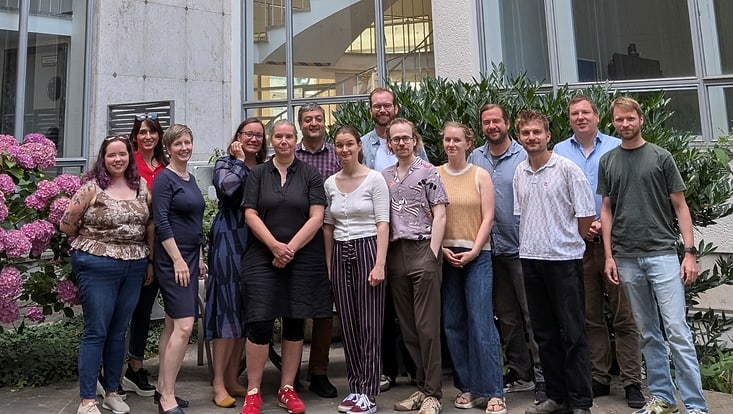
Foto: GESIS/Schmidt
Am 30. Juni und 1. Juli 2026 lud DNA.FRAG zu einem Expert Workshop bei GESIS in Köln. Zwei Tage lang ging es um ein Thema, das öffentliche wie wissenschaftliche Debatten prägt: die Fragmentierung digitaler Nachrichtenpublika und ihre Bedeutung für individuelle Informationsrealitäten wie für den gesellschaftlichen Zusammenhalt.
Der Einladung folgten sieben internationale Expert:innen: Kim Andersen (University of Southern Denmark), Richard Fletcher (Reuters Institute, University of Oxford), Sandra González-Bailón (University of Pennsylvania), Anna Sophie Kümpel (LMU München), Merja Mahrt (Weizenbaum-Institut), Judith Möller (Leibniz-Institut für Medienforschung | Hans-Bredow-Institut) und Harsh Taneja (University of Illinois).
Im Kern ging es darum, wie sich Fragmentierung in digitalen Informationsumgebungen sinnvoll fassen und von verwandten Konzepten wie Polarisierung abgrenzen lässt. Daran schloss sich eine intensive Diskussion an, wie Fragmentierung gemessen werden kann, was sie antreibt und welche Folgen sie auf individueller und gesellschaftlicher Ebene hat.
Durch die vielen unterschiedlichen Perspektiven lieferte der Workshop dem Projekt wertvolle Impulse für die weitere Arbeit. Das Team dankt allen Teilnehmenden für ihr konstruktives Feedback und für zwei Tage offenen und kollegialen Austauschs.
DNA.FRAG ist ein Verbundprojekt von GESIS – Leibniz-Institut für Sozialwissenschaften und der Universität Hamburg. Gefördert wird DNA.FRAG von der Deutschen Forschungsgemeinschaft (DFG).
———————————————————————————
On 30 June and 1 July 2026, DNA.FRAG hosted an expert workshop at GESIS in Cologne. For two days, the focus was on a topic that shapes public and academic debate alike: the fragmentation of digital news audiences and what it means both for individual information realities and social cohesion.
Seven international experts took up the invitation: Kim Andersen (University of Southern Denmark), Richard Fletcher (Reuters Institute, University of Oxford), Sandra González-Bailón (University of Pennsylvania), Anna Sophie Kümpel (LMU Munich), Merja Mahrt (Weizenbaum Institute), Judith Möller (Leibniz Institute for Media Research | Hans-Bredow-Institut) and Harsh Taneja (University of Illinois).
At its heart, the workshop explored how fragmentation can be meaningfully defined in today's high-choice information environments and set apart from related concepts such as polarization. This led into an intensive discussion of how it can be measured, what drives it, and its consequences at the individual and societal level.
With so many perspectives in the room, the workshop gave the project valuable input for its further work. The team thanks all participants for their constructive feedback and for two days of open and collegial exchange.
DNA.FRAG is a collaboration of GESIS – Leibniz Institute for the Social Sciences and the University of Hamburg. DNA.FRAG is funded by the German Research Foundation (DFG).

